
Google Just Changed What It Means for a Website to Be "Search Ready"
For years, business owners have focused on familiar website metrics:
- SEO
- Page Speed
- Mobile Friendliness
- Conversion Rates
- User Experience
Those factors still matter.
But Google has quietly introduced a new category in PageSpeed Insights called Agentic Browsing, and it signals something much bigger than another performance metric.
For the first time, Google is evaluating whether AI agents can understand, navigate, and interact with your website effectively.
This matters because search behavior is changing rapidly.
Instead of only typing keywords into Google, people are increasingly asking questions in:
- ChatGPT
- Bing Copilot
- Gemini
- Perplexity
- AI-powered search assistants
These systems don't simply display a list of links. They analyze websites, interpret content, and recommend businesses directly.
If AI systems cannot properly understand your website, you risk becoming less visible in the places where future customers are searching.
The Shift Every Business Owner Needs to Understand
The traditional customer journey looked like this:
Google Search → Website → Lead → Customer
The emerging journey increasingly looks like this:
ChatGPT → AI Recommendation → Website → Lead → Customer
Gemini → AI Recommendation → Website → Lead → Customer
Bing Copilot → AI Recommendation → Website → Lead → Customer
In other words, your website no longer needs to communicate only with human visitors.
It also needs to communicate effectively with AI systems.
That is exactly what Google's new Agentic Browsing audits are designed to evaluate.
What Is Agentic Browsing?
According to Google, Agentic Browsing audits help determine whether a website is easily understandable and usable by AI agents.
The audits focus on whether AI systems can:
- Understand page structure
- Identify important content
- Recognize buttons and links
- Navigate forms correctly
- Access website information efficiently
- Interact with the site reliably
Think of it this way: while a human visitor can often figure out a poorly designed website through experience and intuition, AI systems don't have that advantage. They rely entirely on structural signals, accessibility information, and machine-readable content to understand your business. If those signals are missing, your website becomes significantly harder for AI systems to interpret.
A Real-World Example: Great SEO, But Failing AI Readiness
One of the most surprising discoveries from Google's new audits is that a website can perform well in traditional metrics and still fail Agentic Browsing.
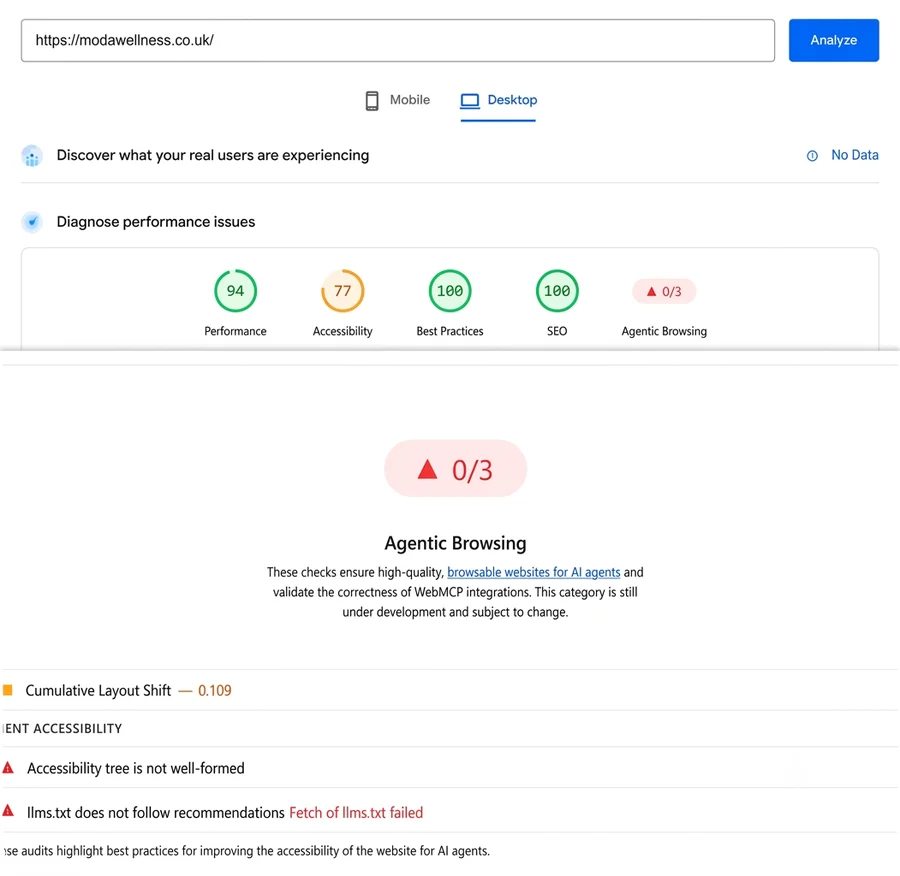 Figure 1: Despite strong Performance, SEO, and Best Practices scores, this website failed Google's Agentic Browsing checks.
The website above achieved:
- Performance: 94
- SEO: 100
- Best Practices: 100
Yet it scored:
Agentic Browsing: 0/3
This is important because many business owners assume:
"If my SEO score is good, I'm covered."
That assumption may no longer be enough. AI visibility and traditional SEO are becoming closely related, but they are not identical. If your website has general search visibility problems, see our guide on why your WordPress site is not ranking on Google.
A website can rank well while still making it difficult for AI systems to understand and interact with critical elements.
What Google's Failed Audits Actually Mean
Let's translate Google's technical findings into business language.
Accessibility Tree Is Not Well Formed
Google flagged:
- Improper ARIA roles
- Missing button labels
- Links without meaningful text
To a business owner, this means:
AI systems may struggle to understand:
- Navigation menus
- Calls-to-action
- Contact buttons
- Form elements
If an AI agent cannot confidently identify these elements, it may have difficulty interacting with your website correctly.
Buttons Without Discernible Text
Example:
A slider button exists visually but lacks meaningful text for assistive technologies and AI systems.
Business impact:
- AI may not understand what the button does.
- Important content may become harder to discover.
- User experience signals can suffer.
Links Without Discernible Text
Google also flagged links lacking descriptive labels.
Business impact:
AI systems may struggle to determine:
- Where the link goes
- Why the link matters
- Whether the destination page is important
That can reduce the clarity of your website's structure.
Missing or Invalid llms.txt
Google reported:
Fetch of llms.txt failed
The llms.txt file is designed to help large language models understand your website.
Think of it as a guide that explains:
- What your website offers
- Important pages
- Key resources
- Preferred content locations
Without it, AI systems receive less structured guidance about your business.
Layout Stability Matters Too
Google also evaluates Cumulative Layout Shift (CLS).
Have you ever tried clicking a button that suddenly moved because another element loaded above it?
Humans find that frustrating.
AI agents can encounter the same problem.
Stable layouts make interactions more reliable for both people and machines. We've written extensively on resolving Core Web Vitals and performance issues in our WordPress PageSpeed Optimization Case Study.
What Does an AI-Ready Website Look Like?
Now compare that with my own portfolio website (NaveenGaur.com), which has been optimized to fully pass Google's Agentic Browsing checks.
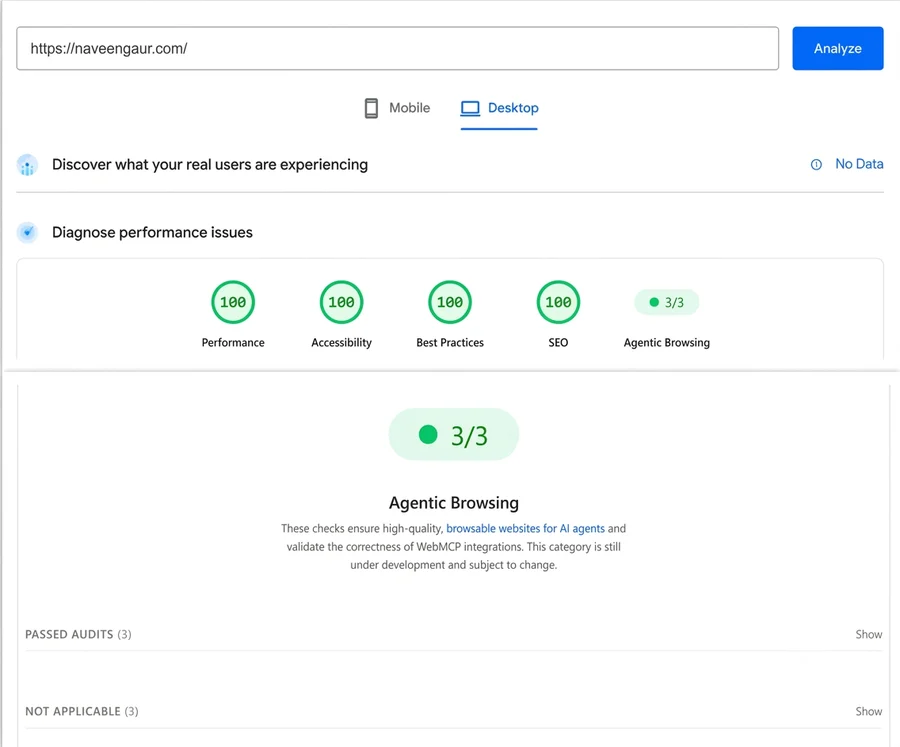 Figure 2: My portfolio website, NaveenGaur.com, successfully passing Google's Agentic Browsing audits with a perfect 3/3 score.
The site achieved:
- Performance: 100
- Accessibility: 100
- Best Practices: 100
- SEO: 100
- Agentic Browsing: 3/3
The goal isn't simply achieving perfect scores.
The goal is creating a website that is:
- Fast for users
- Easy for search engines
- Understandable to AI systems
- Ready for future search behavior
Why This Matters More Than Most Businesses Realize
Many business owners still view AI as something that might affect them years from now.
The reality is different.
AI-powered discovery is already happening.
Potential customers increasingly ask AI systems questions such as:
- "Who is the best WordPress developer?"
- "Recommend a website performance expert."
- "Find an SEO consultant near me."
- "Who can improve my PageSpeed score?"
AI systems then evaluate information from multiple sources before recommending businesses.
If your website provides stronger signals and is easier to understand, you improve your chances of being surfaced in those recommendations.
AI Platforms Are Already Sending Real Traffic
This isn't a future projection—it is already happening. To demonstrate, here is recent traffic data from my own portfolio website, showing the impact of AI referrals and conversational search optimization:
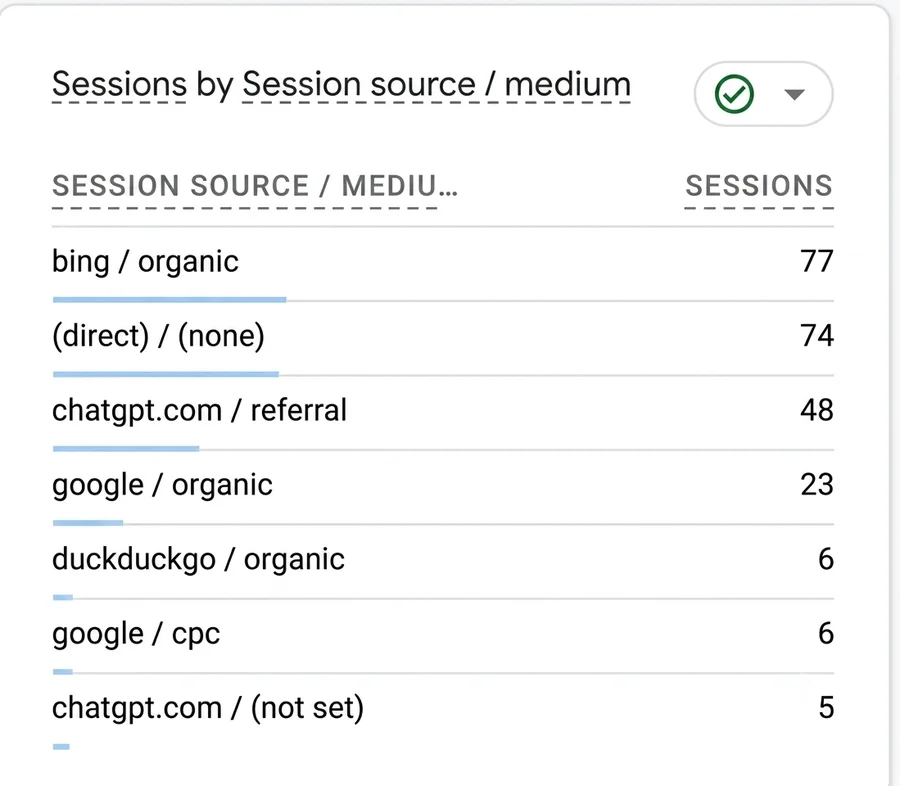 Figure 3: Live traffic sources showing AI-powered platforms (like ChatGPT Referral) generating active sessions on my portfolio website.
| Source | Sessions |
|---|---|
| Bing Organic | 77 |
| Direct | 74 |
| ChatGPT Referral | 48 |
| Google Organic | 23 |
| DuckDuckGo Organic | 6 |
A particularly interesting observation from my own analytics is that ChatGPT referrals generated more visits than Google Organic traffic during this reporting period.
While exact numbers vary by industry, the trend is clear: AI platforms are becoming legitimate, high-intent discovery channels.
What Businesses Should Do Right Now
You do not need to rebuild your website from scratch.
However, there are several practical steps worth taking.
1. Fix Accessibility Issues
Review:
- Missing button labels
- Missing link descriptions
- Improper ARIA attributes
- Navigation accessibility problems
Accessibility improvements benefit:
- Human visitors
- Search engines
- AI systems
For advanced setups where you want to automate accessibility and performance tracking, you can hook your site telemetry into a conversational workspace—see our GA4 AI Agent Guide for how to build this.
2. Improve Website Structure
Use:
- Clear headings
- Logical page hierarchy
- Descriptive navigation
- Consistent content organization
The easier your website is to understand, the easier it becomes for AI systems to interpret.
3. Implement llms.txt
Provide AI systems with a clear, structured overview of your website.
Think of it as helping AI understand your business more efficiently.
4. Monitor Layout Stability
Reduce unexpected movement of:
- Buttons
- Forms
- Images
- Interactive elements
Stable layouts improve usability and machine interaction.
5. Review Agentic Browsing Scores Regularly
Just as businesses monitor:
- SEO
- Performance
- Conversions
Agentic Browsing should become part of ongoing website maintenance.
6. Prepare for WebMCP Adoption
Google's audits also reference WebMCP integrations.
WebMCP is designed to help AI agents identify and interact with website tools, forms, and actions more reliably.
Businesses that adopt these standards early may gain advantages as AI-assisted browsing becomes more common.
The Future of Digital Marketing Is Changing
The next generation of online visibility won't be limited to ranking in search results.
Businesses will increasingly compete for visibility inside:
- AI recommendations
- AI-generated answers
- Conversational search experiences
- Autonomous browsing systems
Traditional SEO remains important.
But websites that are easy for AI systems to understand may gain a significant advantage as these technologies continue to evolve.
The businesses that adapt early are often the ones that benefit most when user behavior changes.
Final Thoughts
Google's introduction of Agentic Browsing is more than another PageSpeed metric.
It is an early signal that websites are increasingly being evaluated not only for human visitors and search engines, but also for AI systems.
A website that is difficult for AI to understand may become less visible in the channels where future customers discover businesses.
The good news is that many of the improvements required are already aligned with best practices:
- Better accessibility
- Clearer structure
- Faster performance
- Improved usability
- Stronger technical foundations
Businesses that invest in these areas today will be better positioned for tomorrow's search landscape.
Need Help Auditing Your Website for AI Readiness?
I'm a Top Rated WordPress and website performance specialist helping businesses improve:
- Google PageSpeed scores
- Website performance
- Technical SEO
- Accessibility
- Core Web Vitals
- Agentic Browsing readiness
If you'd like to understand how your website performs under Google's new Agentic Browsing audits—and what improvements could increase your visibility in both traditional and AI-driven discovery channels—feel free to get in touch.
Related: How to Analyze Your Google Analytics Data with AI: GA4 AI Agent Guide | WordPress PageSpeed Optimization: How We Improved Mobile Performance from 56 to 98 | Why Your WordPress Site is Not Ranking on Google